
Description
Glass and Tempered Glass - Custom-Made to Your Exact Needs
Standard float glass is used for a wide variety of purposes. It has many names: float glass, tempered glass, impact-resistant glass, safety glass, glass sheet for table, cut glass, construction glass, interior glass, glass sheet for table top, splashback glass.
Float glass is available in several different shades, for example clear, grey, extra clear (optiwhite), blue and others. Float glass can also be painted in any color (back-painted glass, white back-painted glass) or have a photo printed on the back. Glass can also be coated, for example to remove reflections from the glass surface.
Tempered Glass (Safety Glass, Impact-Resistant Glass)
If you want to add more safety to standard float glass, you can choose tempering. After tempering, the glass is approximately 3-5 times stronger than non-tempered glass (excluding the edge area), and when broken, tempered glass shatters into small "vacuum-cleanable" pieces, making glass breakage virtually free of cutting hazards.
- Breaks into small granules when shattered, large cutting shards are not possible
- 3-5x stronger surface resistance
- Withstands temperature differences of 200°C (non-tempered only 40°C)
- Maximum operating temperature +300°C
The edges of tempered glass are always ground with coarse belt grinding (even if "Only cut with sharp edges" is selected). Tempered glass always has a small tempering stamp in the corner of the glass.
When is tempering recommended?
- Table glass and glass covers (especially all-glass tables)
- Hearth glass (mandatory due to hot coals)
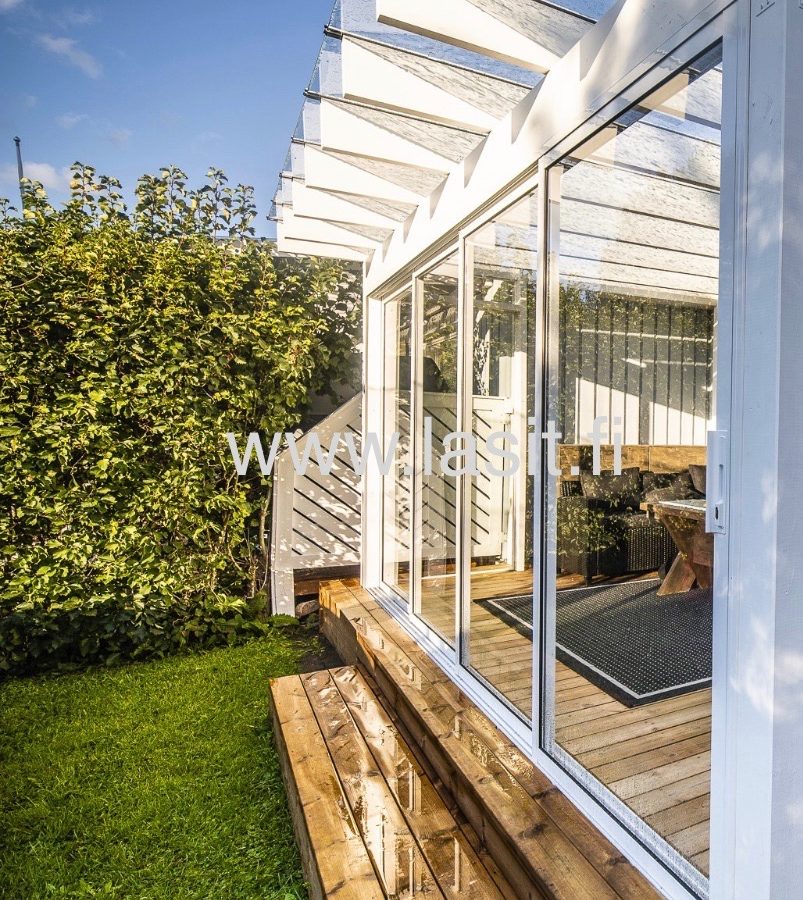
- Terrace glazing (large glass, collision hazard)
- Kitchen splashback glass (heat, mechanical stress)
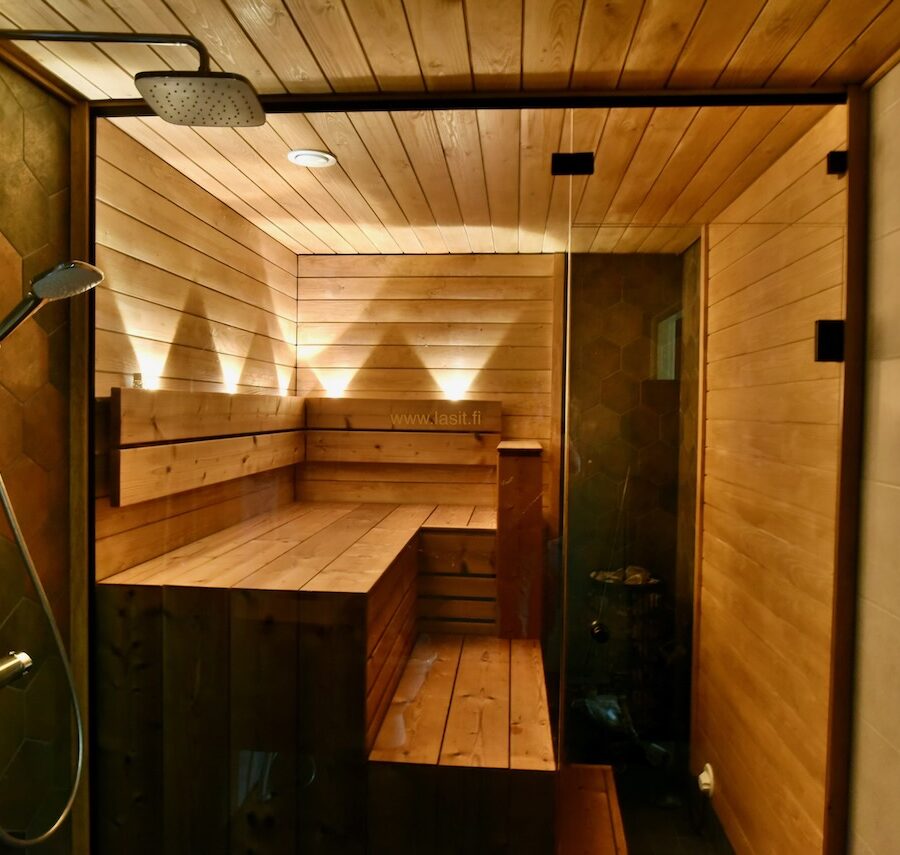
- Sauna glass walls (temperature fluctuations, humidity)
- Glass shelves and walkway glazing
Tempered or laminated glass required:
In buildings and construction generally:
- Public spaces: safety glass (tempered or laminated) when the lower edge of the glass is less than 1500 mm from floor level or less than 300 mm from a door opening
- Private spaces (homes): safety glass when the lower edge is less than 700 mm from floor level, and in doors always when less than 1500 mm from floor level
- Fall-risk locations: tempered glass is not sufficient - always use laminated or tempered+laminated glass, as tempered glass when broken crumbles into small granules and does not prevent falling
Important: Always check current building regulations and consult the structural designer of your project - regulations may change and additional requirements may apply.
Edge Polishing and Finishing
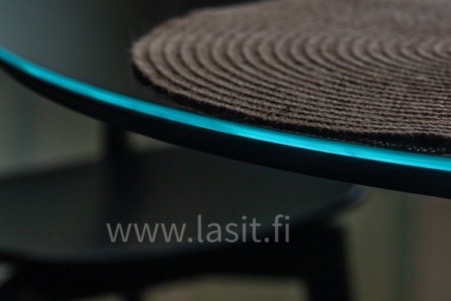
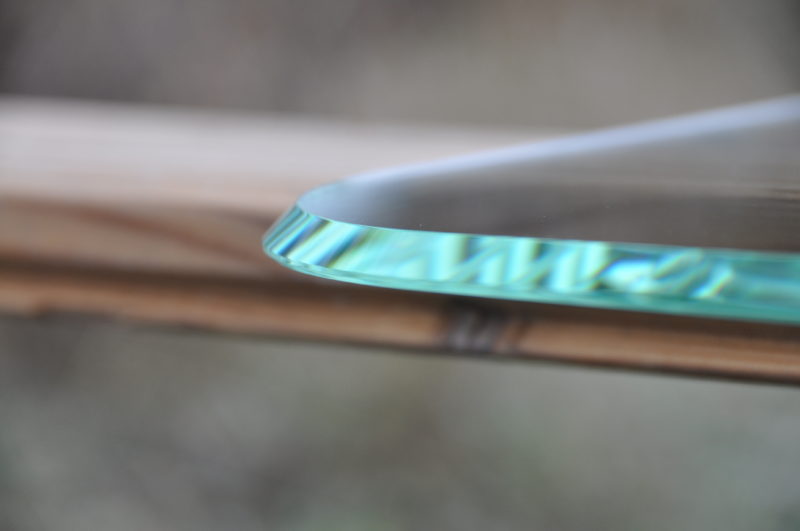
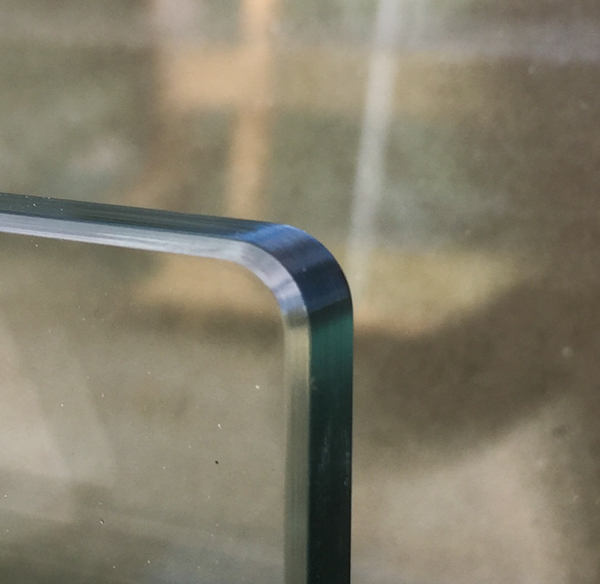
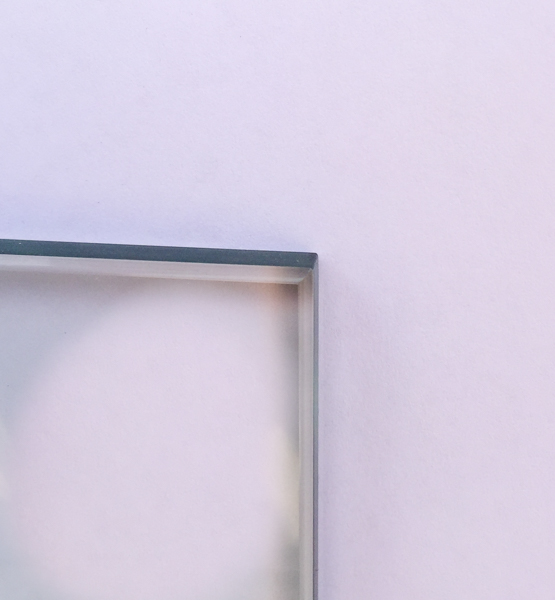
If the glass edges will remain visible after installation, we recommend taking Polished Edge on the glass. The sharp edges of the glass are then ground smooth and polished to presentation quality.
Bevel specialty: If all corners of the glass are rounded with corner radiuses less than 11mm, the bevel is ground in a straight line and does not follow the corner radiuses. Otherwise, the bevel is ground with a CNC machine to follow the edge line of the glass including the radiuses.
Examples of Applications
Window Glass
Usually 4mm or 6mm thick, thickness is selected based on glass size and location. Sometimes the location (e.g. busy walkways and door proximity) requires tempered or laminated glass.
Table Glass (Table Top Protective Glass)
More detailed ordering instructions for table glass can be found at this link: Table Glass Cover
Thickness: Usually 6mm thick, tempered or non-tempered glass.
Edge polishing: We definitely recommend choosing Polished Edge.
Glass type: If the table surface is light or white, we recommend extra clear glass, which significantly reduces the greenish tint that normal glass brings to color reproduction.
Corner radius: We recommend at least a small R2-R3mm corner radius to remove sharpness from the glass corners.
Kitchen Splashback Glass
More detailed ordering instructions for splashback glass can be found at this link: Splashback Glass
Thickness: Usually 6mm thick, tempered or non-tempered glass.
Edge polishing: We recommend Polished Edge.
Glass type: If the protected wall surface is light or white, we recommend extra clear glass.
Hearth Glass (Glass in Front of Fireplace, Spark Guard)
Hearth glass is always tempered safety glass, because people usually have to walk on the glass and hot coals or firewood can drop on the glass.
Thickness: Usually 6mm, but for appearance sometimes also 8mm and 10mm thicknesses are used.
Edge polishing: We recommend always taking at least Polished Edge, or to enhance appearance you can also take beveled or 45-degree grinding.
Corner radius: Front corners should be rounded with at least R10mm radiuses.
All-Glass Load-Bearing Table Tops
Always tempered glass, thickness 6mm, 8mm, 10mm or if looking for a massive appearance, even 19mm glass has been used.
Terrace Wall Glazing
Always tempered glass is used, because:
- Usually terrace structures move more than other fixed structures of the house
- Glass is large-sized
- Terraces are busy walkways
- Greater collision risk with glass on terraces
- Usually glazing also goes quite close to ground level
Terrace wall glass is usually 4mm or 6mm thick tempered glass, depending on glass size, installation method and environmental stresses on the glass.
Terrace Roof Glass
Always tempered thick glass, usually 8mm, 10mm or 12mm. In public spaces, at heights over 4 meters, or with longer spans, tempered+laminated glass is used, for example 8+8mm or 10+10mm for maximum safety.
Glass Shelves
More detailed ordering instructions for glass shelves can be found at this link: Glass Shelf Custom Made
Thickness: Usually 6mm or 8mm depending on shelf width and load.
Edge polishing: We recommend Polished Edge or beveled edge for an impressive finish.
Glass type: Extra clear glass is the most popular choice for glass shelves, as it gives the shelf crystal clarity without the greenish tint of normal glass.
Tempering: We recommend tempering especially for longer shelves and locations where heavier objects are placed.
Sauna Glass Walls
Always tempered glass, usually 8mm or 10mm thick. You can order a ready-made sauna glass wall here.
Glass Types and Special Glass
Extra Clear Glass (Optiwhite, ClearVision, Diamant)
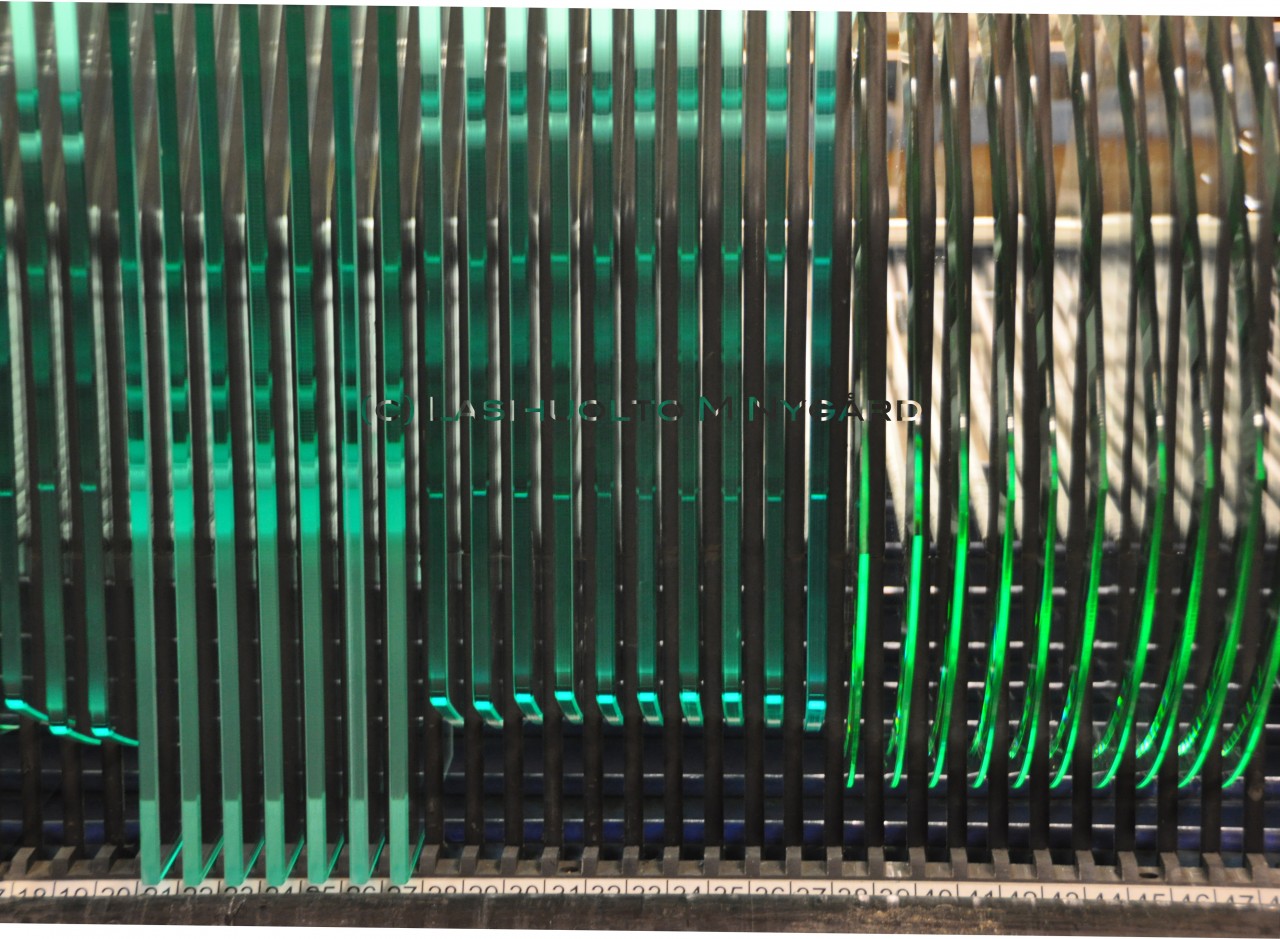
This type of glass is often called by its trade name, for example Optiwhite glass. Extra clear glass is clearer than normal clear glass because extra clear glass has lower iron content compared to normal glass.
Normal Glass
- Greenish tint in thick glass
- White back-painting → strongly green
- Edge dark green
- Good for general use
Extra Clear (Optiwhite)
- Minimal green tint
- White back-painting → purer white
- Edge slightly lighter (not completely clear)
- Recommendation: Interior glass, mirrors, light back-paintings
Extra clear glass (thickness 3, 4, 5, 6, 8, 10, 12, 15 and 19mm) we always keep in stock and are therefore available with short delivery time. For interior glass, the most commonly used thickness is 6mm.
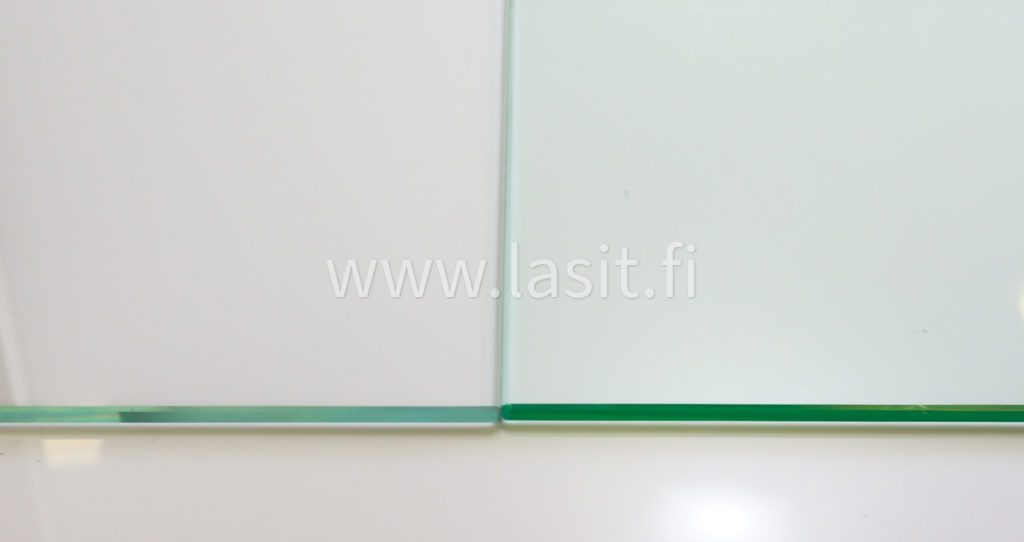
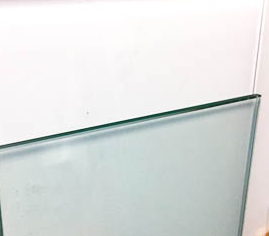
Image: Left extra clear optiwhite glass, right normal glass
Low-Reflection Glass (Pilkington OptiView Ultra DC)
For applications where you want to see extremely clearly through the glass. Glass light transmission is up to 99%.
Tinted Glass
Available in grey, dark grey, bronze, green and blue. Tinted glass can be used:
- For aesthetic reasons
- To reduce solar heat transfer (absorbs solar heat energy)
- Space does not heat up as much as when using clear glass
Frosted Glass (Matte Surface)
The surface of frosted glass is etched to a matte surface, which provides privacy or adds appearance to interior design.
Self-Cleaning Glass
Self-cleaning glass provides convenience and everyday comfort as self-cleaning glass significantly reduces the number of cleaning times the glass needs, but it should be noted that self-cleaning glass does not completely eliminate the need for cleaning.
- For outdoor use
- In a place where the self-cleaning coating of the glass receives plenty of:
- UV radiation from the sun (UV radiation activates the coating and breaks down biodegradable dirt on the glass)
- Rainwater, which rinses away the dirt broken down by the coating (or alternatively hose watering)
Pilkington MirrorPane Chrome and Chrome PLUS (Tempered Mirror)
Pilkington MirrorPane series new state-of-the-art front-coated mirrors can be tempered, ground and processed (holes, millings, etc.) just like normal glass.
Glass Weight
You can also calculate glass weight when you enter glass information in the fields. The glass weight calculator does not take into account the reduction in mass due to the shape of the glass, but always calculates the glass weight of a rectangular area.
Indicative weights (kg/m²):
| 3mm glass: | ~7.5 kg/m² |
| 4mm glass: | ~10 kg/m² |
| 5mm glass: | ~12.5 kg/m² |
| 6mm glass: | ~15 kg/m² |
| 8mm glass: | ~20 kg/m² |
| 10mm glass: | ~25 kg/m² |
| 12mm glass: | ~30 kg/m² |
| 19mm glass: | ~47.5 kg/m² |
Examples of Corner Radius Sizes
R or radius, what size circle part the corner radius is.
Everyday comparisons:
- LP record: Diameter ~300mm → Radius R=150mm
- CD: Diameter 120mm → Radius R=60mm
- 2 euro coin: Diameter ~25mm → Radius R=12.5mm
- 10 cent coin: Diameter ~20mm → Radius R=10mm
R1 - R2 (1-2mm)
Use: Only sharpness removal, barely round to the eye
Recommendation: When minimal rounding is desired but glass remains nearly rectangular
R3 - R5 (3-5mm)
Use: Small but clearly visible rounding
Recommendation: Table glass, shelves - most commonly used size
R10 - R20 (10-20mm)
Use: Clearly rounded corners
Recommendation: Hearth glass (min R10mm), interior glass, design elements
- For table glass we recommend at least R2-R3mm corner radius for safety
- For hearth glass minimum R10mm radiuses for front corners
- If glass goes into a frame, corner radius may not be necessary
Back-Painted Glass
We can paint the back surface of the glass in your chosen color by order. Back-painted glass is suitable, for example, as a glass cover for dining tables, interior glass for walls or kitchen splashback glass, etc.
- Base glass: For back-painting we always recommend choosing "Extra Clear Glass" (optiwhite), which has only a little of the natural green tint of glass. Then the glass color reproduction properties are at their best.
- Color reproduction: Extra clear glass is not completely colorless and the glass also "shades" i.e. darkens the paint color shade slightly, so when viewed through the glass the color is never the same as the same paint shade without glass.
- Black color: Does not change much whether it is painted on normal or extra clear glass.
- Use: Back-painted glass is for indoor use only and the painted side must always be hidden against another surface (table, wall) and protected from scratches.
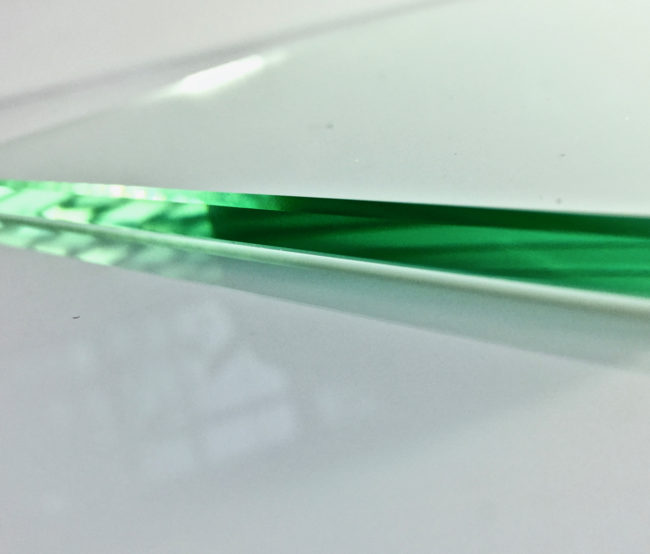
Comparison image: White painting on extra clear vs normal glass
Left: Extra clear (optiwhite) glass - Right: Normal glass
Note the strong greenish tint of normal glass in white painting!
Color selection tips:
- White and light shades: ALWAYS use extra clear glass → Purer result
- Black shades: Normal glass is sufficient, difference is minimal
- Bright colors: Extra clear glass recommended → Colors shine better
- Dark colors: Normal glass works well
Patterns and ceramic digital printing on glass
Ceramic digital printing means a colour is printed onto the back of the glass and fired permanently into the surface during tempering at over 600 °C. It is the same technique you see in the black border of a car windscreen. You choose the printed pattern in the calculator: the most common is the edge fade print, a solid black band (RAL 9005) along the edge that fades inwards as a dot raster, with no hard boundary.
Which patterns can you choose?
The pattern name describes its most common purpose — every pattern can equally be used purely decoratively.
- Edge fade print. Conceals adhesive mounting or structures at the edge of the glass. Soft transition from the solid border to clear glass.
- Bird protection pattern. An evenly spaced dot pattern that makes the glass visible to birds and reduces collisions. Spacing below 100 mm is required for protection.
- Coverage (solar shading). An even dot raster across the whole glass. The coverage percentage determines how much light and visibility remain through the glass.
- Linear fade. A straight-line fade at the chosen angle: a solid area from which the pattern fades to clear glass. Common in shower and sauna glass.
- Safety markings. Horizontal bands at chosen heights from the bottom edge. Makes glass doors and walls noticeable in public spaces.
- Grid pattern. A printed grid window: you choose the number of panes and the spacing is derived from the glass size so the panes come out exactly equal. A flush surface with no protruding bars.
- Anti-slip stripes. Stripes at even intervals in the chosen angle. Used on glass floors, stairs and landings to improve grip.
Patterns can also be combined on the same pane – for example a bird protection pattern together with safety markings.
What is a printed edge used for?
- Hiding adhesive mounting. When glass is bonded with adhesive or tape, the solid band conceals the bond line so the surface looks clean and even.
- Concealing structures behind the glass. Frames, edges and backing surfaces disappear behind the printed area.
- Privacy with a soft transition. The fade screens the view without cutting the surface abruptly the way film does.
- UV protection for the bond. The solid band shields adhesives from direct sunlight.
Why ceramic colour?
The colour is not stuck onto the surface — it is fired into the glass. That makes it resistant to UV light, moisture, wear and cleaning agents, and suitable for both indoor and outdoor use. It cannot be scratched off and it does not fade, unlike wet paint or film.
What to note when ordering
- The glass must be tempered. The colour is fired in the same process as tempering, so the print is not possible without it.
- The print is on the back surface and is viewed through the glass. The calculator drawing shows the glass from the front.
- The edge fade print runs around the entire perimeter. You choose the width of the solid band and the fade zone in millimetres.
- Also available for laminated glass, provided it is tempered.
In the calculator, choose Patterning under "Patterning or back painting", add the patterns you want and set the dimensions with the sliders. The price updates immediately.
Drilling Holes in Glass
You can also order holes in glass at your desired location. There are certain regularities in glass about where holes can be drilled.
- Each glass thickness has its own minimum distances for how far the hole edge must be from, for example, the glass edge, glass corner or another hole
- If glass is tempered into safety glass, these distances are greater than in non-tempered glass
- Distances increase with glass thickness
- There is also a minimum for hole diameter depending on glass thickness
Technical information about holes:
- Edges: Holes are always raw-edged i.e. holes are intended to go "hidden"
- Size: 6-40mm holes are mainly made with diamond drill
- Large holes: Holes over 40mm are made either by drilling or machining with CNC machines
- No upper limit: We can machine almost any size hole in glass
- Edge holes: Holes can also be level with edges, i.e. make half-holes e.g. for cable feedthroughs or hearth glass against round fireplace
💡 Practical tips:
- Glass with holes is recommended to be tempered
- If possible, try to always use the same hole size (cheaper)
- Tempered glass CANNOT be drilled afterwards - all holes must be made before tempering!
- Plan hole locations carefully - measure accurately!
Large-Batch and Project Manufacturing for Glass Professionals
Are you a glass professional, construction company or designer? We have the expertise to deliver even the most demanding projects. If our price calculator doesn't cover the shape, size or structure you need, contact us – we manufacture glass to your drawings. Our production line is designed for both single pieces and hundreds of glasses in the same batch.
Who we serve:
- Shops and commercial spaces: Shelf glass, display cases, splashbacks and back-painted glass for complete projects.
- Boat and marine industry: Tempered glass for cabins, furniture and interiors – series production for boat builders and shipyards.
- Industrial machine and safety glass: Machine guards, sight glasses and equipment glass to your drawings, also as recurring replenishment batches.
- Furniture and kitchen industry: Furniture glass in series production – edge grinding, drilling and tempering included.
- Construction and renovation companies: All the glass for your project in one order, delivered straight to the site.
Factory orders and large batches:
- Drawing or DXF file: Send your own drawing (hand-drawn, PDF or DXF/DWG) and we will manufacture the glass accordingly.
- Sample piece or template: You can also send us an old glass or a cardboard template, and we will manufacture the new one to match.
- Quote for large batches: For larger batches we price separately – request a quote and tell us the quantity, dimensions and finishing. All pieces are manufactured under precise process control, so the quality is consistent throughout the batch.
Why us? We are a glass processor, not a reseller. All cutting, CNC milling and shaping, drilling, grinding and bevelling is done in our own production. This means fast delivery, competitive pricing and flexibility in special orders. Feel free to contact us – we are happy to tell you more.
Frequently Asked Questions
Can tempered glass be cut?
Tempered glass cannot be cut or processed after tempering. During thermal tempering, an extremely strong unified stress zone is created throughout the glass. If this stress is released from any point, the entire glass crumbles into small crumbs. This described crumbling is a safety feature. Therefore, all cutting, grinding, holes, and other processing must be done before glass tempering.
Does tempered glass withstand frost?
Tempered glass withstands frost excellently. Outdoors, however, it should be noted that if meltwater gets into the glazing structure, which freezes at night for example, the ice expanding may squeeze the glass and break it. The glazing structure should be designed so that water does not enter the structure and the structure is ventilated.
Does tempered glass withstand heat?
Tempered glass withstands heat and thermal shocks significantly better than non-tempered glass. The temperature difference inside tempered glass may be maximum 200 degrees, and the maximum operating temperature is +300 Celsius. Heat-resistant glass and Borosilicate glass (Borofloat) withstand heat even better.
When is tempering mandatory?
Tempering is mandatory primarily when building regulations require it, or when broken glass could pose a personal safety risk – regular glass breaks into large, sharp shards that can cause serious cuts. Mandatory or highly recommended applications include: hearth glass (always tempered due to hot coals), sauna glass walls (temperature fluctuations), glass doors and low-positioned glazing (collision risk), and all-glass tables (full weight on glass). Handrail glass is always tempered and laminated to ensure safety. Terrace roof glass is often also tempered and laminated, especially for longer spans.
Why does tempered glass break more easily from the corner?
Tempered glass does not actually break more easily from the corner than normal glass – the difference is what happens when it breaks. When a normal glass corner receives an impact, typically only a small piece breaks off. The safety feature of tempered glass works so that if the stress structure is released from any point – including the corner – the entire glass shatters at once into small, blunt pieces. This is an intentional safety feature that prevents dangerous sharp shards from forming.
Can tempered glass break by itself?
Tempered glass never breaks by itself without a cause.
"I saw a video online where tempered glass shattered by itself without anything touching it..." — The most common reason for this is delayed breakage. The corner or edge of the glass has received a small, sometimes even unnoticeable impact — for example, the glass is lightly bumped against the frame during installation, or a corner hits a hard surface during handling or use. The impact does not break the glass immediately, but it starts a slow process: the impact point begins to fracture the internal tensile stress zone of the tempered glass. The stress is gradually released until the glass suddenly — seconds, minutes, or even hours later — crumbles into small pieces. No one touched the glass, nothing hit it, and it seems completely inexplicable — but the real cause was that earlier small impact.
In over 99% of cases, the cause is exactly this: an impact to the glass corner or edge. In normal glass, the same impact would only chip off a small piece or cause a crack, but the safety feature of tempered glass is that the glass crumbles entirely into small pieces — large, cutting shards must not form from tempered glass.
Tip: corner rounding significantly reduces the risk. Why is the corner so vulnerable? When a glass panel weighing tens or hundreds of kilograms rests on a hard surface with its sharp corner, the entire weight of the glass is concentrated on an extremely small area — a fraction of a square millimetre. According to physics, the pressure at the contact point is enormous, and even a small touch is enough to damage the glass corner. Corner rounding does not eliminate this phenomenon entirely, but distributes the force over a much larger area and significantly reduces the probability of corner fracture during handling and installation.
Another rare cause is severe thermal shock. If, for example, ice-cold water is sprayed on hot glass, different parts of the glass contract at different times — this creates a fracture inside the glass and the tempered glass crumbles as a result of the excessive stress.
The nickel sulfide (NiS) inclusion phenomenon sometimes mentioned in connection with tempered glass is extremely rare in European glass materials with modern glass manufacturing processes. There is also plenty of processed glass from outside Europe on the market, but we always use high-quality raw materials manufactured in the EU.
What is the difference between normal and extra clear glass?
Normal clear glass contains iron, which gives the glass a greenish tint, especially in thick glass and at the glass edge. Extra clear glass (optiwhite, clearvision) is made from raw materials with very little iron, so the glass is significantly clearer and color reproduction is purer. The difference is especially visible in white or light back-painted glass: normal glass appears strongly green, while extra clear glass keeps the color almost pure. Extra clear glass is recommended for all interior glass, mirrors, and back-painted glass.
Does extra clear glass edge show green?
Yes, but significantly less than normal glass. Very small glass pieces (e.g. narrow 50-100mm wide glass shelves) may appear almost crystal clear at the edges, but in slightly larger pieces (e.g. 200mm wide glass shelf), even extra clear glass edge starts to appear green or dark green. Edge green depends on glass thickness, viewing angle, ambient lighting, and edge grinding type.
Is extra clear glass completely colorless?
No, it is not completely colorless, but the difference to normal glass is still significant. Extra clear glass still contains some iron, although much less than normal glass. In thin glass (3-6mm) the difference to normal glass is clear but not dramatic. In thick glass (10-19mm) even extra clear glass starts to appear slightly greenish, although much less than normal glass. If you need absolutely colorless glass, we can deliver chemically purified borosilicate glass as a special solution.
What is the difference between polished edge and beveled edge?
Polished edge means that the glass edge is ground flat at a 90-degree angle and polished clear. The edge looks neat and finished. Beveled edge means that a slanted grinding (usually 10-20mm wide) is made on the glass surface edge area, which brings a classic, luxurious look to the glass and reflects light beautifully. Bevel is usually ground at about 3-7 degree angles. There is also 45-degree bevel, which is steeper and more modern. Polished edge is functional, beveled edge is more an aesthetic choice.
Does table glass need edge polishing?
Yes, absolutely. In table glass, the edges are visible and often touched by hand. Without edge polishing, glass edges are sharp and can cause cuts. We always recommend at least polished edge for table glass. If you want to add appearance, you can also choose beveled edge, which brings a luxurious look to table glass. Edge polishing also slightly increases the glass bending strength.
Can back-painted glass be washed?
You can wash the front side (non-painted side) of the glass normally with glass cleaner. The back side (painted side) does not withstand washing or scrubbing, and must always be protected against another surface (wall, table surface). Never use abrasive cleaners or rough cloths on back-painted glass, even on the front side, as they may scratch the glass. Microfiber cloth and glass cleaner are the best options. Back-painted glass is intended for indoor use and the painted surface is always protected.
Which side of the glass is painted?
Painting is always done on the back side of the glass. When you install the glass on a wall, for example, the painted side is against the wall and the front side of the glass faces the viewer. This way the painted surface is protected from scratches and wear. When you look at the glass from the front, you see the paint color through the glass. This is why we recommend extra clear glass as a base - it distorts the color less than normal glass. In our calculator, when designing back-painted glass, the dimension drawing shows the unpainted front surface of the glass, the painting is on the back.
Can tempered glass be drilled afterwards?
No. Tempered glass cannot be processed in any way after tempering - not drilled, cut, ground, or milled. During the tempering process, an extremely strong stress structure is created in the glass, and if even the smallest flaw is made to it (e.g. drilling a hole), the entire stress is released and the glass explodes into small pieces. All processing - holes, cuts, grindings, millings - must be done BEFORE tempering. It is extremely important to carefully plan all necessary holes and processing during the ordering phase.
Does hearth glass need to be tempered?
Yes, absolutely. Hearth glass must always be tempered into safety glass. Reasons for this: 1) People have to walk on the glass (load-bearing capacity and safety), 2) Hot coals or firewood can drop on the glass (thermal shocks), 3) Metal tools such as fireplace poker can fall on the glass (impacts), 4) When broken, tempered glass shatters into small safe pieces and does not cause cuts. Hearth glass is usually 6mm, 8mm or 10mm tempered glass. Note: hearth glass is NOT the same as fireplace door glass - tempered glass must never be used as a fireplace door glass, which is exposed to direct flame (+700 °C). A fireplace door requires fire-resistant ceramic glass.
Can tempered glass be used as a fireplace door glass?
Absolutely not! Tempered glass must never be used as a fireplace door glass. The fireplace door glass is exposed to direct flame and temperatures that can exceed +700 °C. The maximum operating temperature of tempered glass is +300 °C, so it will break in a fireplace door. Fireplace door glass must be fire-resistant ceramic glass (e.g. Robax or Neoceram), which is designed to withstand direct flame and extremely high temperatures. This is a safety issue - using the wrong glass type can cause a serious fire or personal injury.
Can beveled edge be done on tempered glass?
Yes, but the beveled edge must be done BEFORE tempering. Tempered glass cannot be processed after tempering. When ordering, you select both tempering and beveled edge, and we process the glass in the correct order: first the bevel is ground, then the glass is tempered. Note that the beveled area usually does not fully temper because the glass thickness changes in the bevel. Bevel-edged tempered glass is an excellent choice for example for hearth glass, which requires both safety (tempering) and a luxurious appearance (bevel).
What is fine edge polishing and when is it used?
Fine edge polishing is a matte-finish edge grinding where the glass edge is ground smooth but not polished to clear. The edge appears matte and slightly lighter than when polished. Fine edge polishing is often used: 1) When a matte aesthetic look is desired, 2) When the glass edge is not fully visible but still needs finishing, 3) When you want to reduce edge green tint (matte surface reflects less).
Does color change when paint is behind the glass?
Yes, slightly. Glass "shades" or darkens and slightly changes the paint color. The thicker the glass, the more the color changes. Normal glass gives a strong greenish tint, especially to white and light colors. Extra clear glass (optiwhite) significantly reduces this effect but does not eliminate it completely. Black color hardly changes, dark colors change only slightly, but light and bright colors can change noticeably.
Does back-painting withstand moisture?
Back-painting withstands normal indoor humidity well, but the painted surface must not be in constant contact with water. This is why the painted side must always be installed against a solid surface (wall, table surface). Back-painted glass can be used as kitchen splashback glass and bathroom wall glass, as long as the painted side is protected against the wall. Do not use back-painted glass outdoors or in applications where the painted surface comes into direct contact with water. Upon request, it is also possible to powder coat the glass back, which makes the coating very hard and suitable for outdoor use.
Can holes be partially overlapping?
Yes, they can, but only partially. Holes can overlap by at least 1/3, creating a longer opening. For example, if two 40mm holes are drilled partially overlapping, you can get an approximately 60mm long opening. This is useful for cable pass-throughs or other special shapes. The hole edges may be processed straight if the production method requires it. Note that partially overlapping holes weaken the glass strength in that area, so such glass is always recommended to be tempered. Upon request, we can also machine various shaped openings and millings with CNC.




Reviews
There are no reviews yet.