Description
 What is laminated glass?
Laminated glass is made by laminating two or more glasses together with PVB or EVA laminating film. If the glass breaks, the membranes still hold the two panes together, which means that laminated glass rarely causes an accident if it breaks. This is why laminated glass is classified as safety glass. Laminated glass is used for example as a wide range of safety glass such as: railing glass, safety glass for doors and windows, vehicle windscreen glass, machine glass, sound insulation glass.
The laminating film is between the glasses. The maximum operating temperature for laminated glass is +80C.
Glass can also be tempered before lamination – in this case the glass becomes tempered laminated glass. Tempered glass is also more resistant to temperature differences in different parts of the glass (200 kelvin difference inside the glass, maximum operating temperature 300C – untempered 40 kelvin). However, the maximum operating temperature for laminated glass is +80C. The edges of the tempered glass are always rough ground (even if ‘Cut with sharp edges only’ is selected). If the application is railing glass, we always recommend the use of a polished edge grinding # railing glass .
Border grinding
If the edges of the glass are still visible after installation, we recommend that you also apply a polish to the glass from the edges menu. In this case, the sharp edges of the glass are ground to a smooth finish and polished. ready for presentation. Edge grinding also slightly increases the bending resistance of the glass. If the edges of the glass are hidden inside the frame, edge grinding is not necessary. To add to the appearance, you can also choose to have the glass surface faceted at the edge or 45-degree faceted. When facet grinding glasses, if all corners of the glass are rounded with less than 11mm of angular curvature, the facet grinding is done in a straight line and does not follow the angular curvature. Otherwise, the facet is ground on a CNC machine to follow the edge line of the glass, including the rounding.
dB Rw = ääneneristävyys vapaalla mittausalueella. dB Rw C = painotettu keskitaajuuksiseen ääneen (esim. puhe). dB Rw Ctr = painotettu matalataajuuksiseen ääneen (esim. liikennemelu).
Arvot ovat suuntaa-antavia (simuloitu Lasi Nygård käyttämillä lasilaaduilla).
| Lasityyppi | Paksuus | dB Rw | dB Rw C | dB Rw Ctr |
|---|---|---|---|---|
| Kirkas 3mm | 3mm | 28 | 27 | 24 |
| Kirkas 4mm | 4mm | 29 | 27 | 26 |
| Kirkas 5mm | 5mm | 30 | 29 | 28 |
| Kirkas 6mm | 6mm | 31 | 29 | 28 |
| Kirkas 8mm | 8mm | 32 | 30 | 29 |
| Kirkas 10mm | 10mm | 33 | 31 | 30 |
| Kirkas 12mm | 12mm | 34 | 33 | 32 |
| Laminoitu 33.1 | 6.38mm | 32 | 31 | 29 |
| Laminoitu 44.2 | 8.76mm | 33 | 32 | 30 |
| Laminoitu 55.2 | 10.76mm | 34 | 33 | 31 |
| Laminoitu 66.2 | 12.76mm | 36 | 35 | 34 |
| Laminoitu 88.2 | 16.76mm | 39 | 38 | 36 |
| Laminoitu 1010.2 | 20.76mm | 40 | 39 | 37 |
| Laminoitu 33.2 (Sound Control) | 6.76mm | 36 | 35 | 31 |
| Laminoitu 44.2 (Sound Control) | 8.76mm | 38 | 37 | 34 |
| Laminoitu 55.2 (Sound Control) | 10.76mm | 39 | 38 | 36 |
| Laminoitu 66.2 (Sound Control) | 12.76mm | 40 | 39 | 37 |
| Laminoitu 88.2 (Sound Control) | 16.76mm | 41 | 41 | 39 |
| Laminoitu 1010.2 (Sound Control) | 20.76mm | 43 | 42 | 40 |
| Eristyslasi 2K (4/15/4) | 23mm | 31 | 29 | 26 |
| Eristyslasi 2K (6/15/6) | 27mm | 34 | 33 | 30 |
| Eristyslasi 2K laminoitu (3+3/15/3+3) | 27.76mm | 36 | 35 | 32 |
| Eristyslasi 2K laminoitu (4+4/15/4+4) | 31.76mm | 37 | 36 | 33 |
| Eristyslasi 3K (4/15/4/15/4) | 42mm | 32 | 31 | 28 |
| Eristyslasi 3K (6/15/6/15/6) | 48mm | 34 | 33 | 28 |
Examples of the size of angular rotations: the radius, or R, is the size of the circle of which the angular rotation is a part. Examples of what corner spinning can be compared to:
- The diameter of a long-playing LP is about 300mm, i.e. radius R=150mm
- The diameter of the CD is 120mm, i.e. radius R=60mm
- The diameter of a 2 euro coin is about 25mm, i.e. radius R=12.5mm
- The diameter of a 10 ct coin is about 20mm, i.e. radius R=10mm
- 3mm rounding (R3) the rounding is just visible to the eye from the corner of the round, but the shape of the glass is not yet substantially changed
- The 1mm rounding (R1) doesn’t look much like a rounded corner, but feeling it with your fingertip you can feel that the sharpness has just about disappeared.
Back-painted glass – we can paint the back of the glass in a colour of your choice. Backpainted glass is suitable for example as glass table tops, wall decorative glass, kitchen partitions, etc. You can create stunning decorative elements from the back-painted glasses. For the ground glass of a background painting, we always recommend to choose “Extra Clear Glass”, which has only a little bit of the natural green tint of the glass. This is when the colour rendering properties of the glass are at their best. However, extra clear glass is not completely colourless and it also “shades” the paint, so the colour seen through the glass is never the same as the same paint colour without it.
The black colour does not change much whether it is painted on normal or special clear glass.
Back-painted glass is for indoor use only and the painted side must always be hidden against another surface (table, wall) and protected from scratching.
The picture below compares the white painting on special clear and “normal” clear glass:
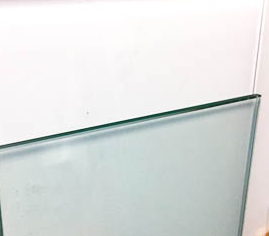
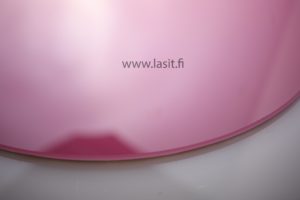
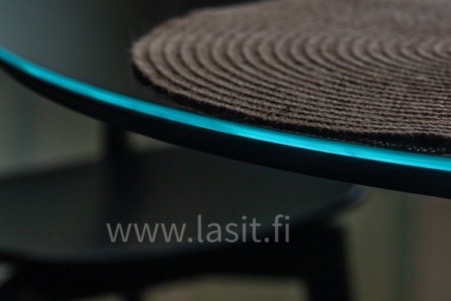
Below is an example of a round special clear glass, painted in Violet 4003:
Drilling a hole in the glass – you can also order holes to be drilled in the glass to your desired location. There are certain regularities in where holes can be drilled in the glass. For example, each glass thickness has its own minimum distances, the distance between the edge of a hole and, for example, the edge of the glass, the corner of the glass or another hole. These distances are larger in tempered glass than in untempered glass and the distances increase with the thickness of the glass. There is also a minimum hole diameter depending on the glass thickness.
- Our calculator always automatically checks that these minimum distances are met and that the hole is not too small for the glass thickness.
- The holes are always rough-edged, i.e. the holes are supposed to go “hidden”.
- 6-40mm holes are usually drilled with diamond drills and holes over 40mm are either drilled or machined with CNC machines.
- There is no upper limit to the size of the hole, we can machine almost any size hole in the glass
- The holes can also be flush with the edges, making the so-called. half e.g. for cable penetrations, etc. or fireplace glass against a round fireplace
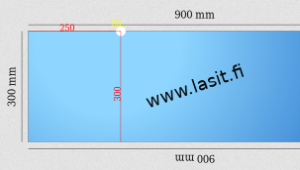

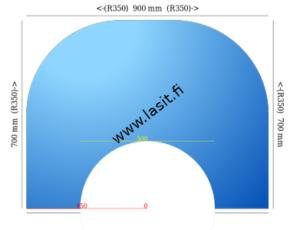

- The holes cannot be too close together, but the holes can partially overlap (min 1/3 part) – this will give you longer gaps. (Hole spacers may be machined straight if production possibilities so require)
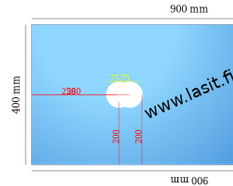

- If possible, always try to use the same hole size (cheaper)
# laminated glass # railing glass # work machine glass # glass sound insulation # soundproof glass
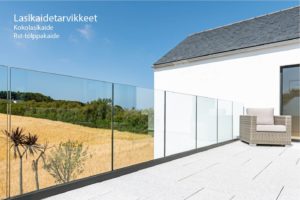
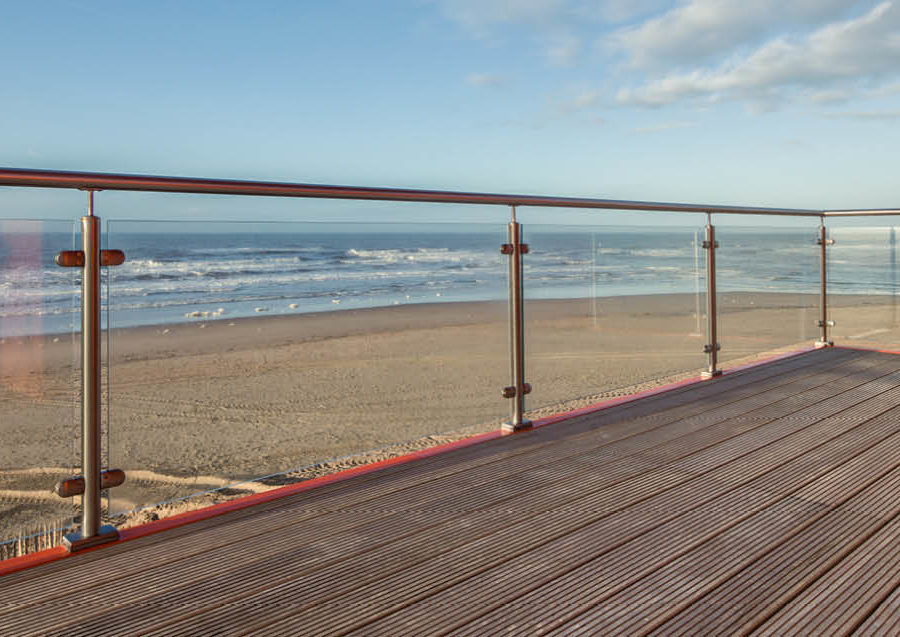
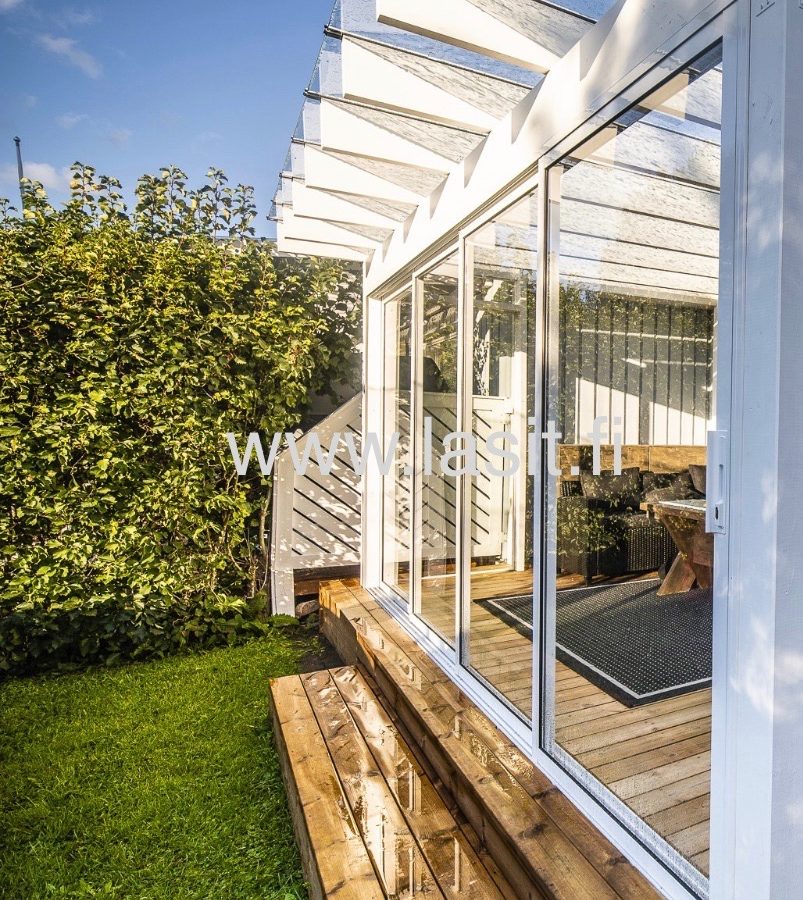
Tempered laminated 8+8mm glass as railing glass in full glass railing
If you have any questions, please do not hesitate to contact.
contact us
– we are happy to help!
In all glass construction, take into account building regulations and their requirements for the load/durability of glass.
What is laminated glass?
Laminated glass consists of two or more glass panes laminated together with an interlayer film (PVB, EVA, or SentryGlass). If the glass breaks, the glass remains attached to the laminating film. Our stock cut-to-size (non-tempered) glass is standard PVB laminated glass. You can ask about other options from our customer service.
How does laminated glass differ from tempered glass and regular glass?
Regular (non-tempered) glass breaks into sharp, cutting large shards. Tempered glass crumbles into small granules. In laminated glass, two or more glass panes are laminated together with an interlayer film. If one glass pane in laminated glass cracks or breaks, the fragments remain attached to the laminating film and the glass retains partial load-bearing capacity (but requires immediate inspection and possible replacement).
Glass can also be tempered before lamination—this creates tempered laminated glass, which combines the benefits of both: the high strength of tempering and the safety of lamination. It should be noted that if both glass panes in tempered laminated glass break simultaneously, load-bearing capacity is lost immediately and the glass must be replaced immediately. In non-tempered laminated glass, if both panes crack, load-bearing capacity is lost but the glass may remain together without collapsing, because the large shards remain attached to the film. Such glass must never be used—it must be replaced immediately.
What are typical uses for laminated glass?
Railing glass, overhead glazing, balcony partitions, stair railings, floor glass (often 3-layer laminated glass), shop windows, and other applications where the safety properties of laminated glass are required. Tempered laminated glass is mandatory for railings and overhead installations.
What is the difference between PVB, EVA, and SentryGlass interlayers?
PVB (standard): Our stock product, suitable for indoor use. Not recommended for outdoor use without edge protection and ventilation due to moisture absorption.
EVA: Much better for outdoor use, more water-resistant (not 100% but significantly better). Request a quote from customer service.
SentryGlass: The strongest option, five times stronger than PVB. Excellent outdoor resistance.
Can PVB laminated glass be used outdoors?
PVB film is not suitable for outdoor use in its standard form unless edges are protected and ventilated. PVB can absorb moisture, leading to delamination. For outdoor applications, we recommend EVA lamination—request a quote from our customer service.
Is railing glass safe?
Yes—correctly dimensioned and professionally installed railing glass is extremely safe! Safety requires, however, that:
1. The correct glass type is used: Railing glass must always be tempered laminated glass (2025 regulations)
2. Glass thickness is correctly dimensioned: Thickness is selected based on span, loads, and fixing method (see "How do I choose the right thickness for railing glass?")
3. Tested fixings are used: All clamps and profiles must have official CE markings and test reports (see "Does it matter which clamps or profiles I use to fix railing glass?")
4. Overall design: The fixing frame, screws, and base must also be dimensioned to withstand loads
For critical installations, we always recommend consulting a structural engineer. When these factors are in order, glass railing is completely safe and also a stunning visual solution!
Why must railing glass always be tempered laminated glass?
According to 2025 building recommendations and regulations, railing glass must always be tempered laminated glass. Previously, non-tempered laminated glass was also used for railings, but the latest calculations and recommendations show that in order for the glass to withstand the required point loads, line loads, wind loads, and other service loads, the glass must be tempered laminated glass. This ensures the glass can withstand impacts and, if broken, does not fall out of the frame, providing maximum safety. The glass thickness is selected based on span and loads.
Can railing glass be just a single tempered glass without lamination?
ABSOLUTELY NOT, if it is a proper railing glass with a fall height from one level to another. If tempered glass breaks, it immediately crumbles into small granules and falls out completely, which means the safety and fall protection provided by the railing is completely lost. This creates an immediate life-threatening danger.
Exception: A glass railing where there is no fall height at all from one level to another can be just tempered glass. These include, for example, windbreaks in private homes or decorative/privacy railings where the levels are at the same height and there is no risk of falling (e.g., a windbreak at the edge of a terrace where the terrace level continues on both sides of the railing at the same level). Even in these cases, the glass must withstand all required loads (wind load, point load, etc.), and dimensioning must be done carefully.
What is the basis for laminated glass strength design?
Laminated glass strength design is ALWAYS based on the principle that a single individual glass pane must withstand all required loads (point load, line load, wind load, etc.) completely independently. The second glass pane acts as a backup glass, which only takes the loads if the first glass breaks.
CRITICAL ERROR: If laminated glass is incorrectly dimensioned based on the combined thickness and combined resistance (e.g., thinking that 2×6 mm = 12 mm total glass), the consequences are catastrophic. When the first glass breaks, all loads are immediately transferred to the second glass, which alone cannot withstand the loads—it breaks immediately after. Result: both glass panes break almost simultaneously, load-bearing capacity is completely lost, and safety is compromised. This is why laminated glass design must ALWAYS be based on the principle that a single pane withstands the full loads, and the second pane is additional safety.
How do I choose the right thickness for railing glass?
Glass thickness depends on three main factors: span (distance between fixing points), loads (point load, line load, wind load), and fixing method. IMPORTANT: Each case must be calculated individually!
Absolute minimums depending on fixing method:
Fixed on one side (e.g., railing glass base rail fixing or glass clamps on only one edge): Absolute minimum is 8+8 mm tempered laminated. One-side fixed glass acts as a strong lever arm, which creates large bending moments in the glass, so a stronger thickness is mandatory.
Fixed on two sides (fixed at the ends): Note that glass height has a significant effect on glass deflection! A lower glass deflects more easily than a tall glass, even if the span between fixing points remains the same. Generally, it is recommended that glass fixed on two sides should be at least 800 mm high or higher due to improved technical strength of the glass. However, always take into account building regulations regarding railing height and glass side clearances (i.e., how much empty space may be left around the glass, objects that can pass through, etc.)—check with building control.
Fixed on four sides (e.g., framed railing): Absolute minimum can be 4+4 mm or 5+5 mm tempered laminated. With four support points, loads are distributed more evenly, so thinner glass may be sufficient.
Railing glass typically ranges from 4+4 mm to 15+15 mm tempered laminated glass depending on strength requirements.
Thickness is selected by calculating span, loads, and fixing conditions. Never guess—incorrectly dimensioned glass can break in use. We always recommend consulting a structural engineer.
What should be considered when installing railing glass?
The entire system must be designed carefully: glass type, glass thickness, fixing method, clamping depth, and the frame, screws, and all fasteners must withstand point loads, line loads, and wind loads.
CRITICAL NOTE - Overall Design: Even thick glass won't help if the structure fails elsewhere! Examples of dangerous situations:
• Concrete breaks underneath because fixing point loads were not calculated correctly
• Wrong type of fixing screw rusts through over time outdoors
• Thin deck board to which the railing is attached tears away from railing forces
• Fixing profile is too weak and cannot withstand loads
The entire chain from mounting base to glass is only as strong as its weakest link. Correct glass dimensioning is useless if the fixing structure fails. Consider overall design—every part is equally important! For critical installations, we always recommend consulting a structural engineer.
Why must railing glass edges be polished even if hidden?
Edge polishing (ground or polished edge) is mandatory for railing glass and other load-bearing structures for structural reasons. Unpolished edges contain microscopic cracks, and sharp edges are weak points. Under load (wind, point load, temperature), these microcracks can grow and lead to glass failure. Polished edges remove these microcracks and ensure full glass strength. This is a critical safety requirement—even if the edges are completely hidden in the mounting profile.
Can laminated glass be used as overhead glazing (anti-fall protection)?
Yes, but it requires precise engineering. The following must be calculated and verified: glass type, glass thickness, fixing method, clamping depth, and that the frame, screws, and all fasteners can withstand point loads, line loads, wind loads, and snow loads.
In heated buildings or public spaces, overhead glazing must use laminated glass. For heat treatment, it is recommended to use heat strengthened glass or, in some cases, fully tempered glass. The final glass type and thicknesses are determined by a structural engineer by calculating loads and conditions.
How is laminated glass cut and processed?
If laminated glass is not tempered, it can be cut and processed at any time with specialized tools. Cutting laminated glass is a demanding and precise procedure: the glass is cut from both sides at the same location, each cut is snapped before cutting the next side, then the laminating film is melted open with an electric resistance heater, cut, and separated.
If laminated glass is tempered, it cannot be processed in any way after tempering. All holes, cuts, and edge finishing must be done BEFORE tempering and lamination.
Should laminated glass be tempered if it has holes?
Yes, it is HIGHLY recommended! Individual glass panes in laminated glass are usually thin, and they easily crack at the hole location if the glass is not tempered. Non-tempered glass cannot withstand the twisting or compression forces around the hole—the glass easily cracks from the hole during use.
In very rare cases, a hole can be made in non-tempered laminated glass, but this is an exception, not a recommendation. Generally: if laminated glass has holes, the glass panes should be tempered before lamination. This ensures the glass's durability and safety.
Where can I order tempered laminated glass?
You can order tempered laminated glass from our webshop at www.lasit.fi. Select BOTH tempering AND lamination in the configurator, as well as shape, quantity, edge finishing, and other required features. For EVA lamination or special projects, contact our customer service for a quote.
Does it matter which clamps or profiles I use to fix railing glass?
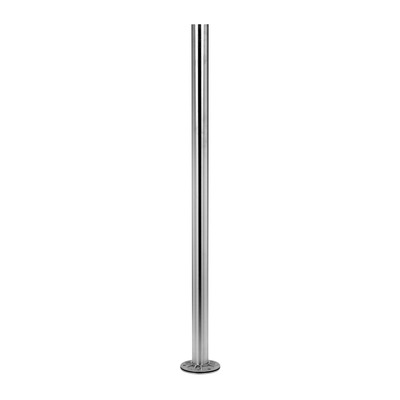
Yes—and this is a critical safety issue! Railing glass can be fixed in several ways: clamping glass clamps, point fixings, floor-mounted base rails, or U-profiles. Every clamp and profile must be tested and certified specifically for railing glass use.
DANGER: Wrong products on the market
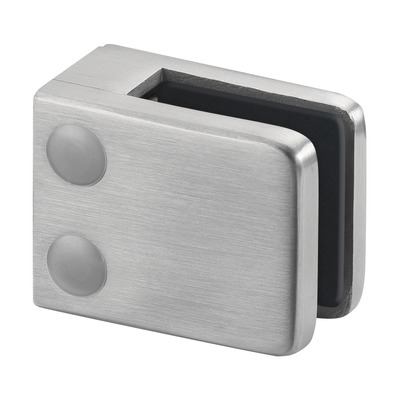
Online and in stores, you often see very similar-looking products (such as clamping glass clamps) with huge price differences. Why? One clamp may look exactly the same in photos but is actually only thumb-tip sized and lacks test reports (and wasn't even originally intended for railing glass), while another is palm-sized and has proper CE markings and load tests. Some products are designed only for windbreak use or display case dust protection—not to protect people from falling!
Real-life examples of dangerous situations:
Example 1: For instance, in one concert hall auditorium, a base rail+glass combination was found that was rated for only 50 kg load (residential use)—being used to protect massive crowds from falling! This is life-threatening.
Example 2: A customer brought us broken glass pieces as a sample and asked us to make a new "railing glass" to replace the broken one—a child had bumped into the railing, the glass had cracked and fallen out of its fixings from the upper floor to the ground floor. When we examined and assembled the old glass pieces, we discovered that the glass was 2500 mm long, thin regular laminated glass, fixed at the ends with some clamps found online that had only a 15 mm clamping area. Not a single part of this package was even theoretically strong enough...and the list goes on.
Often it's a matter of ignorance, sometimes also negligence—the cheapest possible option that doesn't even meet regulations is installed in a contracted project, "as long as it's laminated glass".
What you must do:
• Demand official test reports and CE markings from all railing glass accessories
• Verify that the product's performance values (load-bearing capacity) are sufficient for your specific application
• Don't trust a seller's word that "no one has ever fallen through these"—demand documents
• Always use a structural engineer for railing design
• Be especially careful with products imported from outside the EU—the market has many untested products that don't meet requirements
✓ Properly designed glass railing is extremely safe!
Correctly dimensioned and professionally installed railing glass is a 100% safe solution that you can be completely confident about. Additionally, glass railing is a visually stunning choice—modern, airy, and bright solution that brings a sense of space and elegance. Glass railing increases property value and creates a unique atmosphere in both indoor and outdoor spaces.
Invest in quality, safety, and beauty—glass railing is a decision you'll enjoy for decades!




Reviews
There are no reviews yet.